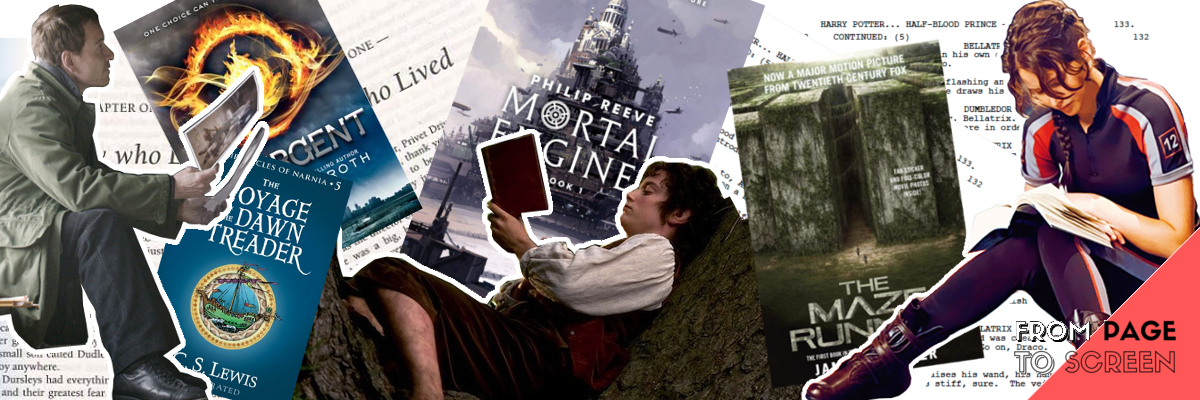
What makes a good film adaptation? From classic literature to the current best-seller, Hollywood’s obsession with turning page to screen shows no sign of waning and here are some of the top things we look for in a successful adap.
This one should be self-evident. You should not have to do homework to understand a film. A successful screen adaptation needs to be accessible to people who are not familiar with source material, be that a book, play or even a news article. The film should contain all the information which the audience needs to understand the characters and the plot. If you come out of the cinema and the answer to any of your questions is “oh but it makes sense in the book”**, then the film-makers did not do their job.
Book authors often have the advantage of telling a story over hundreds or thousands of pages and Sci-Fi and Fantasy series in particular contain a huge amount of lore that can be difficult to squeeze into your average run-time. (Terry Pratchett all but film-proofed his Discworld series by building a universe over 40 books). Screenwriters and directors must balance out the supply of relevant information with maintaining an entertaining pace for the film. Not having a scene at Madame Malkin’s in the Harry Potter films did not leave us wondering where on earth all of these wizards got their robes, but the revelation that Barty Crouch Jr had masterminded the whole of Goblet of Fire would doubtless have puzzled more than a few people who had not read the book.
Even when the audience has already invested in the literature, there is no guarantee they will be impressed with the cinematic retelling. Almost every review for 2017’s The Snowman was written by a Jo Nesbo fan and even they didn’t seem to get it. The predicted enthusiasm of Hunger Games aficionados had dissipated somewhat by the final film and the less said about the Divergent Mortal Engine of Maze Running Insurgents the better (RIP YA dystopia).
To excuse a half-ass film adap by saying it was “made for the fans” therefore does not hold water. It goes without saying that a movie based on stories or characters with a pre-existing fan-base will often be targeted towards that audience, but they rarely set out to actually exclude anyone. Why would they? Films exist to make money and every bum in a cinema seat is a return on investment for whichever studio first snapped up the rights to that particular publishing sensation. Limiting the audience to those who have already read the book/comic/play is blatantly counter-productive.
We would add, somewhat less cynically, that if the film-maker is a true fan of the material, they wouldn’t waste the opportunity to introduce it to a new audience. In fact, one mark of a successful film adaptation might be that it draws a new audience to seek out the source material, not to fill in plot-holes but simply to spend more time with the characters. Alex would almost certainly never have read any of Tolkien’s work had it not been for Peter Jackson’s LOTR trilogy and something tells us she’s not alone.
In the next part – why the movie can’t be a slave to the material.
**Sidenote – Emily is often guilty of including this in her defence of movie plot holes, though even she can’t defend 1998’s Les Miserables
 Cinema Sisters
[…] Page to Screen : Part 1 – The Film Must Stand Alone […]
LikeLike
“Starter for Ten” by David Nicholls was (imho) a really funny, moving comic novel. The film, by contrast, was much less funny and much less moving. A large part of that – I think – boiled down to the lack/dearth of the protagonist Brian’s narrative voice.
In the book, much of the comedy is in the stark difference between how he sees himself (his past, his feelings, his insecurities, his motivations, etc. – all of which is expounded at length in his narration), how he wants himself to be seen by others, and how others actually see him.
In the movie, the viewer is mainly seeing him only as other characters see him.
I guess the lesson is to work hard to really identify where a book’s “charm” actually comes from, and then sympathetically render it in cinematic form. Perhaps the film would have been improved if there had been more in the way of narrative voiceover.
Similar issue with Brideshead, the movie. Apart from the fact the book was ruthlessly condensed to a suitable screen-time, and therefore a lot of nuances lost, it suffered from a lack of Charles’s internal voice. The television series surmounted this obstacle with reasonably extensive narrative voiceovers.
Maybe there are other techniques beside voiceovers, but they seem like a pretty powerful, simple and effective tool for film adaptations.
LikeLike