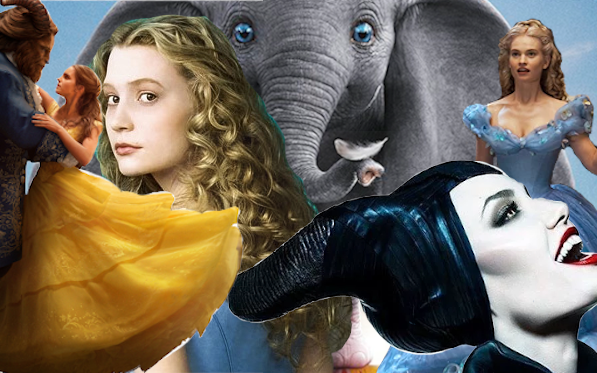
Another day, another Disney live-action remake. You can’t seem to move for them nowadays. Already this year we’ve had Dumbo and Aladdin, and we’re just weeks away from Jon Favreau’s much hyped Lion King (which is not technically live action – wildlife campaigners would probably have a field day if someone tried to make a meerkat ride a warthog). Have they just run out of ideas? Or are remakes a valid, perhaps even necessary, way of bringing these much-loved films into the 21st century and making them resonate with a modern audience? Disney have taken a number of approaches in their live-action remakes, to mixed results. With perhaps their most anticipated release on the horizon, Cinema Sisters look back at the beguiling and the befuddling offerings from the House of Mouse.
We start in 2010 with Tim Burton’s Alice in Wonderland, more a reimagining of Lewis Carroll’s story, than a straightforward remake of the 1951 cartoon. Burton, as always, brings his unique aesthetic and whimsical style to proceedings, but while he and Wonderland may seem like a match made in heaven, the film begs to differ. Let’s get one thing straight, Burton is at his best when he grounds his oddball characters in the mundanities of everyday life (think of the suburban setting of Edward Scissorhands), and forces his audience to question who the real “freaks” are. But his particular brand of quirky mixed the Carroll’s acid-trip of a novel was just too much weirdness in one place, and that’s before you add Johnny Depp’s bonkers performance as the Mad Hatter into the mix. The film also tried way too hard to shoehorn itself into the action/fantasy genre; the climax of the film sees Alice save Wonderland from the evil Jabberwocky in a generic CGI battle, and while I applaud Burton for daring to stray from the source material, turning the sweet and naïve Alice into an action hero is completely incongruous and forced. Finding ways to bring Disney’s posse of female protagonists into the modern era was a hurdle that all remakes would need to clear, sadly Burton’s effort fails to do justice to the character. Unsurprisingly, the film received a lukewarm response from critics (51% on Rotten Tomatoes), but was generally praised for its spectacular visuals. More importantly, it was a hit with audiences and, buoyed by the box office receipts, the studio green-lit a sequel, 2016’s Alice Through the Looking Glass, this time with The Muppets’ James Bobin at the helm. It was a critical and box-office disaster, and the less said about it the better. Still, Burton remains the only filmmaker bold enough to make a significant departure from the cartoon (more on Dumbo later), while all subsequent Disney live-actions have stuck more closely to the story beats and visual styles of the originals.

©Disney
Next in line for a revamp was 1959’s Sleeping Beauty, which became 2014’s Maleficent. Directed by Robert Stromberg (who had served as production designer on Alice), it borrowed the formula from Wicked and recast the titular witch as the hero of the story. While the result was hardly a critical success (it scored 54% on Rotten Tomatoes), it fulfilled the criteria of presenting its audience with something new, while keeping enough of the cartoon (notably in the character design for Angelina Jolie) to satisfy a nostalgic audience, and keep the film feeling safely Disney. The film makers also brought the story up to date, by ditching the superficial love story between Aurora and Prince Philip (no not that one), in favour of a deeper and more meaningful relationship between Maleficent and the young princess.
This focus on the villain helped Maleficent to tiptoe around the central problem of most early Disney fairytales, namely that the heroines are boring, damsel-in-distress types, who don’t chime much with modern audiences, which brings us nicely to Cinderella. Keira Knightley hit the headlines in October when she announced that she had banned her daughter from watching the 1950 Cinderella, as she felt the central character was a bad role model for young girls. As Knightley put it “she waits around for a rich guy to rescue her. Don’t! Rescue yourself. Obviously!” To be fair, she’s not wrong, but I would argue that Kenneth Branagh’s 2015 effort does a lot to address this problem. There’s a sense of purpose to Lily James’ Ella; she doesn’t just sit around waiting to be saved, rather she feels duty bound to protect the memory of her parents, and the home they built together. She perseveres through hardship and humiliation at the hands of her evil stepmother (Cate Blanchett’s performance is reason enough to love this film), and never fails to heed her mothers advice: “have courage and be kind”. Sure, it’s a little on the cheesy side, but as role models go, you could do much worse.

©Disney
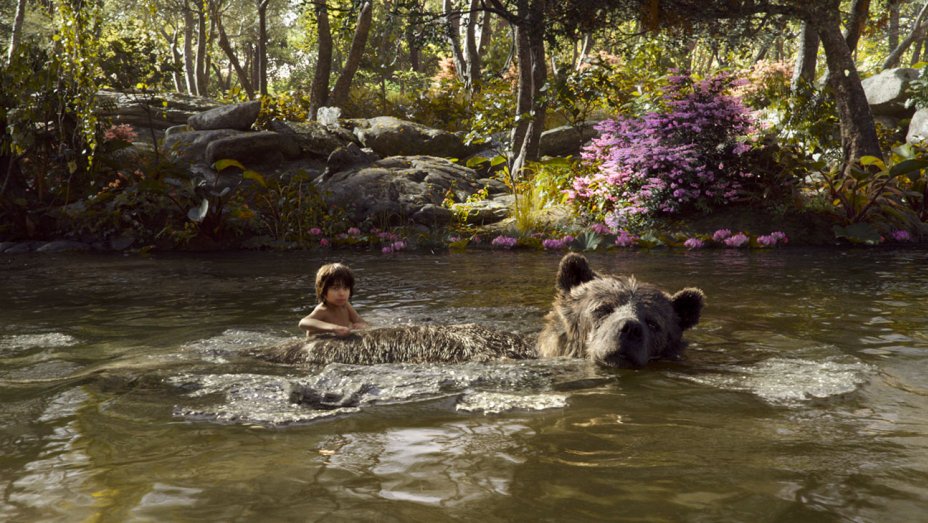
The other main strength of Branagh’s film is that he makes the most of this opportunity to add depth, texture and scale that wasn’t there in the old-school 2D. The same is true of Favreau’s not-technically-live-action but visually stunning Jungle Book. This film may not have given us anything new to ponder on a character or story level, nor did it have a particular socially-relevant message, but it was worth the price of admission just to see the CGI characters rendered in such a life-like manner. Disney proved that when it puts its mind to it, it is still at the cutting edge of animation.
©Disney
Up until now all the films mentioned have had one thing in common: whether its dull leads or outdated animation, the cartoons on which they are based have all obvious room for improvement. So what would happen when the studio started to tackle the so-called ‘renaissance’ films? Films which already showcased a more modern sensibility, and which still impress today. We got our answer in 2017 with the release of Bill Condon’s Beauty and the Beast. Here is where I take leave of my senses and indulge in a little rant (I apologise in advance if you liked this film, I did not)… For starters, any semblance of originality was thrown out the window in favour of an almost shot for shot remake of the 1991 original. Perhaps they were afraid of the fan backlash if they dared to make any changes to the beloved cartoon. Or maybe they came to the conclusion that the original can’t be improved on, which begs the question – why bother with the remake? Yes, the new film tries to justify its own existence by giving its characters a little more back-story but most of what they added is superfluous at best. Belle’s mother, it turns out, died of tuberculosis – was I the only child who never considered the whereabouts of the mum a ‘mystery’ that needed to be solved? It doesn’t really add anything to the plot, and it ends up giving more depth to the father’s character than to Belle herself, and as brilliant as Kevin Kline is, was anyone really clamouring for some Maurice back-story? They also made Belle an inventor, to the extent that she invented a washing machine and then… did absolutely nothing else with her skills. At no point does the new character trait actually tie into the plot, and it’s not as though they didn’t have the opportunity: at the beginning of the third act Belle and Maurice are locked in the back of a cart, to escape all they have to do it pick the lock. We’ve seen (or rather been told) that Belle is good with mechanics, so this shouldn’t be beyond her, and while it’s only a small gesture, it’s an opportunity for a female character to demonstrate ingenuity and self reliance, to be the one doing the rescuing, rather than just being another damsel in distress. And what does she do? She pulls out a hairpin and hands it to her dad. It was all I could do to stop myself from throwing something at the screen. This is just one example of how the film failed to live up to its promise of being a feminist retelling (the marketing of the film leaned heavily into Emma Watson’s feminist credentials), and let’s not get started on the ‘first openly gay character in a Disney film’ debacle. Actually, let’s. The much-hyped scene essentially amounts to a misstep during the final musical number, which results in two men dancing together. Ground-breaking, right? Even more baffling than Condon’s description of this as “an exclusively gay moment” (whatever that means), is their decision to play it for laughs. The entire film also reeks of green screen and sound stages, and it feels cramped where it should feel expansive. But the joke’s on me really because the fact is that for all it’s lack of imagination, the film garnered respectable reviews and did exceptionally well at the box office, and it’s hardly surprising, the source material is so good, and so beloved, that it would be hard to go too far wrong. (Rant over, phew!)
Next up was this year’s Dumbo, with Disney once again handing the reins to Tim Burton (haven’t they learnt their lesson?). I confess, I didn’t see this one, and given the indifferent response it received from audiences and critics alike, I’m not likely to. The original clocked in at 64 minutes (that’s about one episode of Game of Thrones) so it was obvious that they were going to have to make some serious departures from the cartoon to turn it in to a feature length live action film. They essentially had the opportunity to make an almost entirely original film, which makes its failure all the more disappointing.
And so we come to Disney’s most recent (re)release, Aladdin which, more than any of its predecessors, had an opportunity to do something truly innovative, and gave it up in favour of the safe option. Let’s start with the Genie. Robin Williams’ performance is undoubtedly the most memorable part of 1992’s original, so it seems natural that the big story, when it came to the remake, revolved around the casting of Will Smith as Al’s magical BFF. But the reality is that the Genie is a secondary character (a plot device, really), and in the cartoon he doesn’t even appear until the second act. One of the huge problems with this year’s Aladdin, was that it was so desperate to get to the cave of wonders and “show us the money” that it galloped through the opening scenes (there’s a point during ‘One Jump’ where the film literally plays at double speed) and in doing so it sacrificed character development and tension building. What they fail to grasp is that what Robin Williams achieved was a happy accident, you can’t plan for that, and it seems ludicrous to make an entire film revolve around a sidekick. Never mind the fact that the more focus you put on the Genie, the more you invite unfavourable comparison. What director Guy Ritchie and writer John August should have done was accept the fact that Williams’ performance couldn’t be replicated, or even matched, and refocus the film on its central characters and narrative.

©Disney
In doing so, they would also be able to focus on a much more socially relevant part of the film. You see, by this stage Disney has become more or less adept at handling its female characters (in this one Jasmine proves her worth as the next, and rightful, ruler of Agrabah), and the fact that they have more depth and agency has become an expectation rather than a hope. But Aladdin brings something new to the table; namely, that it is set in the Middle East, and features a cast made up almost entirely of people of colour. In this diversity-minded world (and industry), I was surprised to see that so little was made of this fact, because let’s be honest, Middle Eastern people have not been well represented on screen. Admittedly, there were minor rumblings when it was announced that Billy Magnusson had joined the cast as Prince Anders, but nothing like the public outcry that prompted Ed Skrein to depart Hellboy (in retrospect a lucky escape for him), or Scarlett Johansson to leave the upcoming Rub & Tug. The film could have been a real step forward in the portrayal of the East on screen, a move away from the magical exoticism of early Hollywood, and the terrorist-tropes of the last decades. Instead it feels more like a jumble of Eastern stereotypes. And while it might seem ridiculous to talk about authenticity in the depiction of a fictional place, let’s not forget that Aladdin came out just a year after Black Panther (another Disney property). Like Agrabah, Wakanda is a made up place but, unlike Agrabah, it feels real. You can sense the effort, and the attention to detail that went into to creating the Wakandan aesthetic, the production designers didn’t just settle for something that looked ‘a bit African-y’, they pulled elements from real African cultures, and combined them in a way that felt both authentic and original. And, by giving each of Wakanda’s tribes a distinct look, they also paid tribute the diversity of cultures on the continent. In comparison, Aladdin’s cartoonish take on Eastern culture seems wholly out-dated, and more than a little disappointing. If I could change one thing about Aladdin it would be this: hire a Middle Eastern director, introduce some real diversity into the creative team and show some respect for the culture that this story comes from. We can only hope that next year’s Mulan does a better job.
As to whether any of these retreads are strictly necessary: the jury is still out. I appreciate the need to provide children with better role models and more socially conscious messages, but could that be done by creating new and original stories? To be fair, none of the animations were original to begin with, they all borrowed from folklore, fairy tales, classic children’s literature and even (at a push) Shakespeare, but there’s something about the self-cannibalisation of this new crop of films, that makes their existence feel like little more than a money grab (an effective one at that). It will be interesting to see how The Lion King fares this summer. Favreau pulled it out of the bag with The Jungle Book, and judging by the trailers the CGI looks scarily good. But like Beauty and the Beast, I’m struggling to think of ways that they could improve on the original, and I hope they find a way to make it feel relevant and necessary, not just an empty visual spectacle.
 Cinema Sisters
Well said! More please!
LikeLiked by 2 people
Definitely think Disney are in part doing it because they know it will bring them revenue and some of these stories as they are are always being used as examples of misogyny and sexism in the press, which means they need to revise their reputation and this is the most lucrative way. Also other animation houses have become way more successful in the west, where Disney’s audience has been so focused only them for so many years. Now Japanese studios are working with western animators more, and cgi etc was also an easy way to break away from these competing new films, while being different enough from action films like marvel etc. At least that is my impression of the topic!
LikeLiked by 2 people
Great piece, although I humbly take issue with the incidental Black Panther authenticity panegyric. The “authenticity” drive was targeting an African-American audience – struggling with an identity crisis – and not an African audience, to whom Wakanda will have seemed bafflingly unfamiliar, even accounting for the “Afro-punk” technological upgrades.
Imagine that waterfall duel transposed to a magical European enclave setting, with a guy in Lederhosen fighting a Morris dancer, or a sequinned matador locking swords with his kilted opponent. To European eyes, it would be a laughable pastiche.
And why do all of these different tribes with their own distinct identities conveniently speak with one tongue, which conveniently happens to be English? This is supposed to be a nation which was never colonised by European powers. Would it have been so hard to use an existing African language, or invent a new language and use subtitles, rather than have the mainly British/American actors ham it up with a generic “African accent”?
And on that point, apart from Lupita Nyong’o, how many of the characters were actually played by Africans? How many of the writers/producers and directors were African? A tiny proportion.
Nate Moore called the costume/set design a “love letter to Africa”, with inspiration noted as drawn from tribes based in Uganda, Rwanda, Burundi, Congo-Kinshaha and Ethiopia. That averages at maybe a tenth of the African continent by land mass and population, and entirely excludes North Africa, most of West Africa, and most of Southern Africa. In reality, it’s a love letter to specific parts of East Africa.
There’s nothing wrong with that, of course, but the head writer attempting to pass off (parts of) East Africa and the African continent as being broadly synonymous, culturally speaking, surely undermines any claim to authenticity.
Black Panther may have been original, but it surely wasn’t authentic.
LikeLiked by 1 person
All very good points, and maybe I should have been a bit more specific when I talked about the ‘authenticity’ of Black Panther’s production design (I was conscious of the growing word count). What I meant was that it was obvious that a lot of care had been taken to research and draw inspiration from real African cultures. I agree that it’s pastiche, but I’m not sure that it’s laughable. I’m also not sure I agree that West and Southern Africa are excluded from the mix; throughout the film characters can be seem wearing Kente cloth, and British-Ghanaian designer Ozwald Boateng was brought on to create some of the costumes, and (when they’re not speaking English) the Wakandans speak Xhosa, which is an official language of South Africa.
As to how many of the cast and creative team are African, according the African Union almost all of them are, given it considers the diaspora to be the sixth region of Africa. (This is probably not the forum to have this conversation, just pointing out that the “who is African?” question is a complex one).
LikeLike
I had many of the same reservations from the first trailer – I worried that the design would undermine the story by crassly pouring a bunch of stereotypes into one fictional magical land and making the audience gawp at a backward idea of “Africa”. I was thoroughly delighted to have been proved wrong. It seemed to me the details which were included proved that the production designers had really done their research and were not only showing respect for a wide variety of cultures, but I didn’t feel like it was patronising in the process. Of course, the experience of watching a film is very personal, so your reaction is perfectly valid and thanks for taking the time to share it!
LikeLike
[…] classic is all but guaranteed to be the biggest box-office hit of the summer. As we’ve noted, Disney remakes have been hit and miss, but fingers crossed this one won’t […]
LikeLiked by 1 person